There are many things I love in this life. God. Family. The Great Outdoors. Writing code. Reading good books. Writing on Substack. Friends. Pizza. Fishing. Ah well, you get the point. What a time to be alive, the world in tatters, AI upending everything we have taken for gospel for the last … well forever. Because I’m an old curmudgeon, I learned to write Perl as my introduction to code, used to run LAMP stacks on macs underneath my desk and watching everyone to try hack it. That being said, while everyone else is ringing their hands in the error and retching like Gollum at how AI has stolen our precious, our code; I just ignore it all, and do both, use AI for coding when required or expected, and still writing Rust by hand when I get chance for fun.


Read more

I recently had a bit of a self-identity crisis; of course, it was tied to spending way too much time on social media. I do try to avoid the worst of it, got rid of Twitter (X) this year, and mostly stick to Substack, LinkedIn, YouTube, occasional Reddit, and Hacker News. Probably still too much.

I’ve always seen it as a form of self-preservation, probably due to growing up the youngest of five in the middle of the prairie next to the river, in the only county without a working stoplight.

I try to be pragmatic and never dogmatic, except when someone says “Production” and “Notebook” in the same sentence.

Read more

A few things have not changed in the age of AI, where the LLM has replaced 3/4 of the brain power of a whole generation of engineers who once found their meaning in the code they wrote. I mean, I hate to say it’s true, but a lot of folk should have been finding their meaning in the code they decided NOT to write. It’s the classic mix-up of smart engineers and developers thinking that their “use” or “importance” to a company or product was the amount and cleverness of the code they put out. They worshipped at the feet of their own fingers, enamored with staring at themselves in the mirror, convincing themselves they were smarter and could write better code than those around them.

Read more

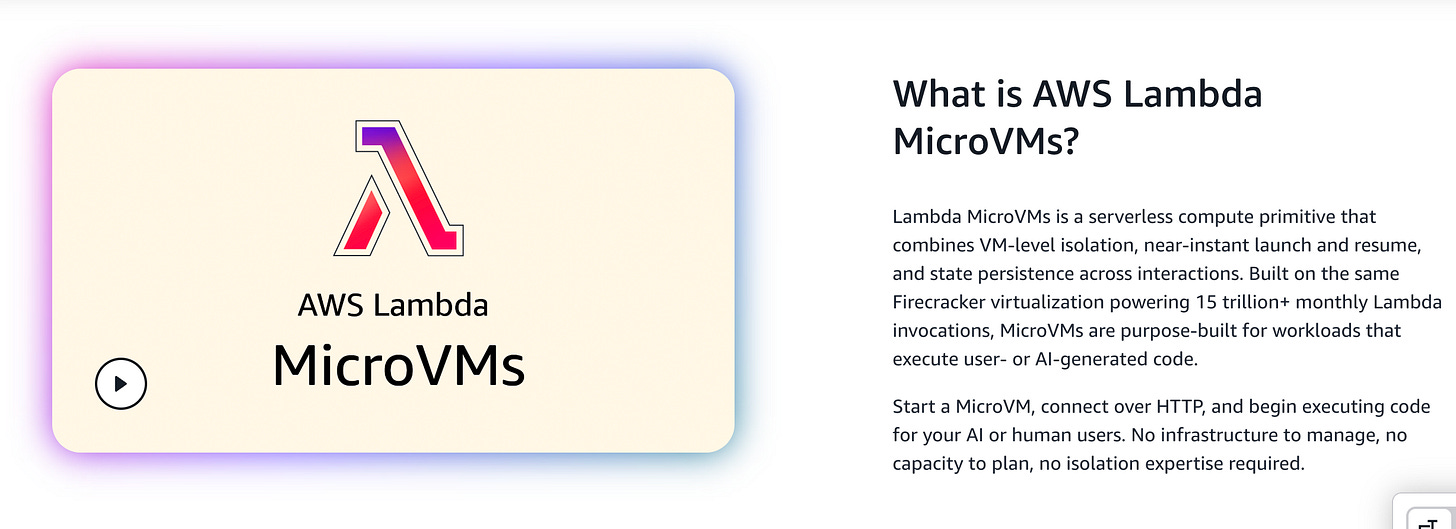
When AWS announced Lambda MicroVMs, I was genuinely excited. After years of incremental services and endless feature releases, it finally looked like AWS had built something that filled the awkward gap between Lambda and EC2. On paper, it sounded perfect. You get VM-level isolation, more memory, persistent state, and startup times measured in milliseconds, all without managing infrastructure. If you’ve ever wished Lambda had fewer limitations or EC2 required less babysitting, this looked like the answer.

Then I actually built something with it. Needless to say, I felt betrayed, lied to, and taken for a ride. Not a happy camper am I.

Read more