
DuckDB Labs acquired by AWS. What does it mean?
Ok, I’m just going to give it to you straight. No beating around the bush, you came here for the DuckDB Labs bought by AWS news right? Wondering what that means? What does it mean for DuckDB? What is DuckDB Labs, even? Never fear, I got you boo.
What is DuckDB Labs?
This is a good question, many people might be confused from the start what exactly is DuckDB Labs? You’ve probably heard of the widely popular DuckDB open-source project, I’m sure.
“DuckDB is a high-performance analytical database system. It is designed to be fast, reliable, portable, and easy to use. DuckDB provides a rich SQL dialect with support far beyond basic SQL. DuckDB supports arbitrary and nested correlated subqueries, window functions, collations, complex types (arrays, structs, maps), and several extensions designed to make SQL easier to use.
DuckDB is available as a standalone CLI application and has clients for Python, R, Java, Wasm, etc., with deep integrations with packages such as pandas and dplyr.” – DuckDB GitHub
DuckDB has taken the data world by storm, it’s small, fast, lightweight, SQL based and easy to use. It was created and is still run by one of the nicest and kindest communities of developers and founders I’ve seen in some time. The DuckDB team has also been the masters of marketing and developer experience. Everyone who uses DuckDB, loves it.
So where does DuckDB Labs come in?
It’s basically a team of founders and developers who created DuckDB; you could call them the core maintainers, if you like. DuckDB itself is open-source and will apparently remain so, but that isn’t the only question at hand. The question is, who “controls” DuckDB? Don’t forget we have MotherDuck rattling around as well, the cloud platform providing managed DuckLake and DuckDB compute, etc.
What you have to remember at the end of the day, with any open-source project, is that most likely the creators and core founders or people control what happens to that “open source” project. Think the Linus of Linux, the people(s) at the top of the ladder who pull the strings and control the direction of what happens with the project.
What does DuckDB Labs say who they are and what they do?
“We are the core development team behind DuckDB, the in-process analytical database built for simplicity, portability, and speed. Based in Amsterdam, our team of more than 30 engineers and researchers maintains the open-source project, guides the architecture, designs new features, and stewards the long-term roadmap of DuckDB and DuckLake.
Our work spans all layers of the system: query planning, vectorized execution, storage formats, extensions, data lake integration, language bindings, and performance optimization.
Alongside our engineering work, we collaborate closely with the community and with the DuckDB Foundation — the independent non-profit that safeguards DuckDB’s intellectual property and ensures that DuckDB remains open-source under the MIT license in perpetuity.” – source
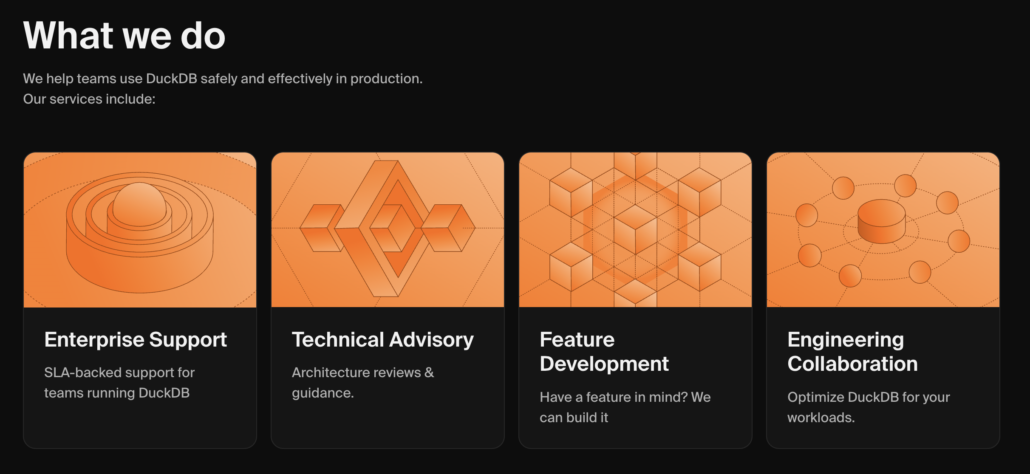
At the end of the day, DuckDB Labs is made up of the foremost experts in DuckDB because they made it, and they provide services to large organizations and any organization that wants to use DuckDB for production workloads and is serious about it. Think of it like specialized consultants on steroids for DuckDB.
So why did DuckDB Labs sell to AWS? They tell you themselves in their blog post announcement.
“We founded DuckLabs a little over five years ago to give the team behind DuckDB a stable, long-term home.
At the time, DuckDB was beginning to gain real momentum. The first commercial contracts to prioritize features were materializing, and venture capital firms were calling. We chose a different path: a bootstrapped company, fully owned by its founders and development team.”
They explain more …
“We also worried that scaling DuckLabs into a much larger sales, support, and operations organization would pull our attention away from the technical work and open-source community that made DuckDB successful in the first place…..
Our partnerships work best with highly technical organizations – often companies with substantial database expertise of their own. Reaching a much broader group of users requires us to solve more complete and specialized problems, serve the needs of different industries, invest substantially more in infrastructure, and reach people who may never think to seek out an analytical database directly.
We believe the DuckDB revolution can grow by another couple of orders of magnitude. To give it that opportunity, we realized we needed a different setup.“
Anywho, you can read it all for yourself. At the end of the day, this isn’t really that new or groundbreaking, as far as some corporation buying up whatever they can when it comes to data tooling and infrastructure. Think Databricks buying Tabular, the creators of Iceberg.
Control the controllables. You would probably do the same if you were AWS; they are the winners of the cloud infrastructure world, but clearly companies like Snowflake and Databricks have carved out serious empires. It makes sense that someone would see DuckDB’s incredible rise in popularity and usage and want to be a part of that.
Will DuckDB really continue to be free and open-source into the future? Of course it will. Does it change things going forward? Of course it does. Just like Databricks calling the shots on alot of Apache Spark, Delta Lake, and Iceberg (as they should), this gives AWS a hand in the DuckDB world. Some people like it, some people don’t.
DuckDB is correct in saying that AWS can supercharge and distribute DuckDB and DuckLake projects like nobody’s business. Of course they can, and will. Does this make some people uncomfortable and unhappy, for whatever reason? Dreams of darkly hooded ninjas creeping around in the night doing bad things? People will always believe conspiracy theories. Doesn’t make them true. It’s the way of the open-source world; stop living in a la-la land where you pretend this doesn’t happen.
I’m sure the DuckDB of the future will be even stronger and more popular than it is today.
Why did AWS acquire DuckDB Labs? Because it would kinda be stupid not to.

