SQLMesh is an open-source framework for managing, versioning, and orchestrating SQL-based data transformations.
It’s in the same “data transformation” space as dbt, but with some important design and workflow differences.


What SQLMesh Is

SQLMesh is a next-generation data transformation framework designed to ship data quickly, efficiently, and without error. Data teams can efficiently run and deploy data transformations written in SQL or Python with visibility and control at any size.

So … what you are telling me is that it’s dbt … but with Python? Interesting enough concept, I should say. One would have to surmise that most people using SQLMesh would be using … SQL! Look at how smart I am.
Read more

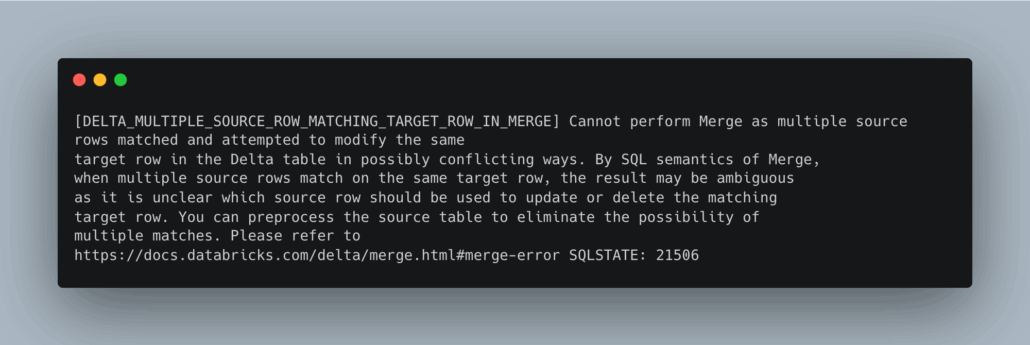
You know, after literally multiple decades in the data space, writing code and SQL, at some point along that arduous journey, one might think this problem would be solved by me, or the tooling … yet alas, not to be.

Regardless of the industry or tools used, such as Pandas, Spark, or Postgres, duplicates are a common issue in pipelines, and SQL remains the most classic and iconic problem. Things just never change, and humans never learn their lessons, at least I don’t.

Read more

In my never-ending quest to plumb the most boring depths of every single data tool on the market, I found myself annoyed when recently using DuckDB for a benchmark that was reading parquet files from s3. What was not clear, or easy, was trying to figure out how DuckDB would LIKE to read default AWS credentials.

Read more

Have you ever wondered at a high level what it’s like to build production-level data pipelines on Databricks? What does it look like, what tools do you use?

When you’ve been data modeling as long as I have, it gets to be the same old … same old.

People make data modeling harder than it has to be. There is a lot of jargon that gets thrown around … third-normal-form, OLAP, OLTP … I give you the 3-4 basics that are at the core of data modeling.

I recently did a challenge. The results were clear. DuckDB CANNOT handle larger-than-memory datasets. OOM Errors.  See link below for more details.

DuckDB vs Polars – Thunderdome. 16GB on 4GB machine Challenge. 


It’s true, even if you don’t want it to be. SparkSQL is destroying your data pipelines and possibly wreaking havoc on your entire data team, infrastructure, and life. In your heart of hearts, you’ve probably known it for years. With great power comes great responsibility. We all know that even us Data Engineers are human and fallible.

Once those tentacles of SparkSQL get their hold on you, the probability of survival is low. Sure, there are a few wizened old engineers with enough battle scars to make it through unscathed. The rest of us will be maimed.

Read more

Sometimes I just need something new and interesting to work on, to keep me engaged. A few days ago I was lying by the river next to a fire, with the cold air blowing on my face and the eagles soaring above. Thinking about and contemplating life and data engineering … something flitted across my mind, just a little fragment of an idea someone had written about.

The little fragment had to do with Datafusion, a Rust-based query engine, and something about it having a SQL CLI interface.

What an interesting thing. I’ve used Datafusion a few times, here and there, I love Rust because it’s fast. I’m a Data Engineer so I’m eternally enslaved to SQL whether I like it or not. This whole thing just seemed like an interesting little tidbit to poke at.

It basically made me wonder if I could combine the Datafusion SQL CLI with bash into a new ETL tool. Simple, small, fast, and maybe fun? Just because I can?

Read more

One thing all Data Engineers are doomed to do in purgatory will be to solve different date and datetime problems in an endless loop. I’m sure of it. I can’t imagine anything worse, so that must be it. Either way the constant need to manipulate dates and datetimes are just a way of life, something that never ends and never changes. Also, it appears Polars is here to stay from what I can tell. Not a fad like that Data Mesh. Since Polars is here to stay, (I’ve already got it running in production at my company, (don’t mind if I bow)), we should probably take a gander at how to manipulate date and datetime objects from both the Dataframe and (if I have time) SQL perspective. See if we can find anything to complain about. I like to complain.

Read more